Material guide
Natural Marble for Sculpture
Marble is carved rather than formed, which makes it the least forgiving material we work in — there is no adding back. It gives a quality of light in the surface that nothing else reproduces, and it brings two constraints that decide most designs before they start: weight, and what happens when water freezes in a detail.
The material
What natural marble for sculpture is
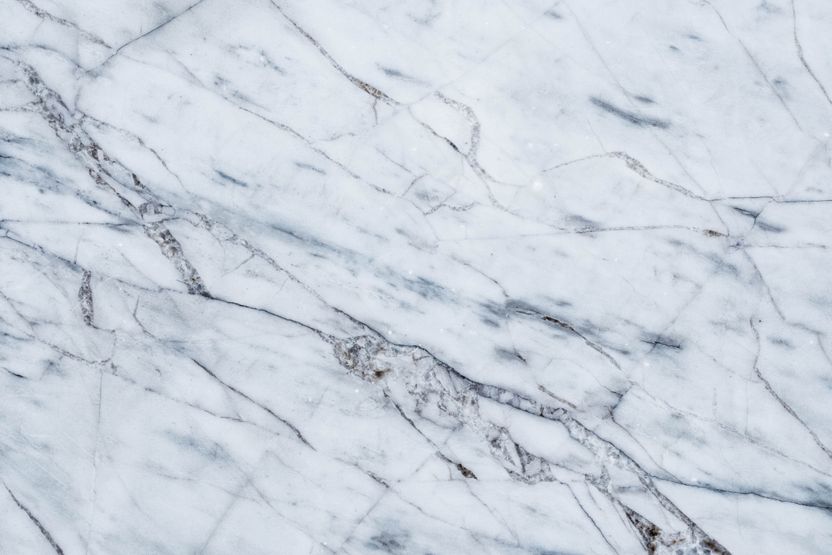
Marble is metamorphosed limestone: calcium carbonate recrystallised under heat and pressure into an interlocking crystal structure. That structure is what gives it translucency — light penetrates several millimetres before scattering, which is why a carved marble face looks alive in a way a cast one does not. Bianco Carrara C is our standard white; Statuario is whiter with more dramatic veining and costs considerably more; Crema Marfil and Nero Marquina are used where the palette calls for them. Blocks are selected at the quarry for soundness, colour consistency and vein direction.
Over time
How it weathers
Outdoors, marble dissolves very slowly in rainwater, which is naturally slightly acidic. Over decades this softens crisp arrises and gives an aged surface that most people find desirable — it is why antique statuary reads as it does. Polished faces lose their polish outdoors within a few years and go matt, unevenly if the exposure varies across the piece. In urban air with sulphur dioxide present, gypsum crusts can form in sheltered areas and blacken. None of this is failure; it is the material doing what it does.
Specifying it
When to specify it
Specify marble for formal settings, for memorials, for interior work where translucency matters, and where the structure beneath can genuinely carry the weight. Do not specify it where floor loading is constrained, where the piece will be within reach of vehicles, or where a freeze-thaw climate meets a design with horizontal ledges and mouldings that hold water. Reconsider it where the programme is short: block selection alone can take two weeks and carving is measured in months.
The drawback
Runoff and staining
What this material does to the surfaces underneath and around it, and what that costs to put right.
Marble does not stain what is beneath it, but it stains itself, and that is the drawback specifiers should ask about. Iron in the stone or in fixings bleeds rust-coloured marks that are effectively permanent — which is why every dowel and cramp we use is A4 stainless, never mild steel, and why a piece bedded on a mortar containing the wrong sand will show it within a year. Organic staining from leaf litter, planting and standing water is common at the base of garden pieces and needs a poultice rather than a wash. The most serious issue is freeze-thaw: water sitting in a moulding, a fold of drapery or an upturned palm will freeze and spall the surface, and once a face has spalled it cannot be repaired invisibly. We design bases and mouldings to shed water completely, hone rather than polish anything running wet because a polished face in continuous water contact etches into a patchy shine, and we advise against sealing at ground level, where the stone needs to breathe rather than trap moisture behind a coating.
Upkeep
Maintenance
What is genuinely required, and what is sold as required and is not.
Wash with clean water and a pH-neutral cleaner. Never use acidic cleaners, vinegar, or bleach — acid etches calcium carbonate on contact and bleach greys the stone. Remove organic debris and standing water. Interior polished work can be re-polished; exterior work generally should not be, because it will simply go matt again unevenly. Biological growth on shaded pieces is removed with a proprietary biocide, not a pressure washer.
For the specification
Technical data
Bianco Carrara C: density 2,700 kg/m³, compressive strength 130–150 MPa, flexural strength 15–20 MPa, water absorption 0.1–0.2 per cent. A 5 m obelisk at 1.2 m square runs to roughly 6,200 kg. Sections dowelled in A4 stainless with structural epoxy. Sandblasted inscription depth 0.8 mm typical; hand-cut lettering 3–6 mm. Grain oriented along the axis of greatest tensile stress.
Speak to an engineer
Whether natural marble for sculpture is right for your site depends on exposure, footfall and who maintains it. Describe the position and we will tell you what we would specify, and what we would not.
We respond to every quote request within one working day