Material guide
Corten Steel for Outdoor Sculpture
Corten is a weathering steel that rusts deliberately and then stops. The oxide layer it forms seals the surface, so the material needs no coating and effectively no maintenance. It is the default choice for landscape sculpture, and it has one real drawback that most suppliers do not mention until after installation.
The material
What corten steel is
Corten is the trade name for a family of high-strength low-alloy weathering steels, standardised as ASTM A588 and A242 and as EN 10025-5 grades S355J0WP and S355J2W. Small additions of copper, chromium, nickel and phosphorus change the way the steel oxidises: instead of the loose, flaking rust of mild steel, it forms a dense, tightly adherent patina that seals the surface and slows further corrosion by an order of magnitude. The mechanical properties are those of ordinary structural steel — 355 MPa yield — so it is designed and welded conventionally, with a matched or slightly over-alloyed consumable so the weld weathers at the same rate as the parent metal.
Over time
How it weathers
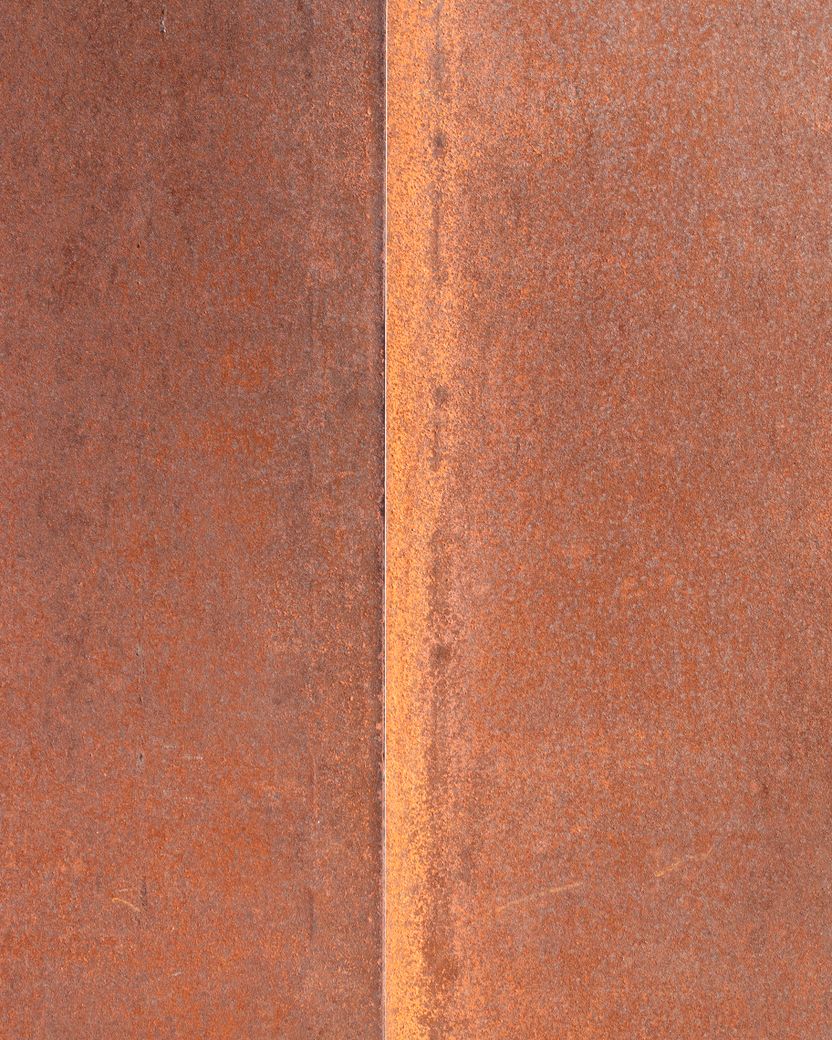
Weathering needs wet–dry cycling. In the first weeks the surface goes an even orange; over six to eighteen months it darkens through russet to a deep purple-brown and the colour stabilises. Sheltered faces that never get wet weather more slowly and stay lighter, which is why an overhang or a soffit will read differently from an exposed face for years. In a genuinely dry climate the patina may never fully stabilise, and in a permanently wet or salt-laden one it will not stabilise at all — corten within a few kilometres of the sea continues to corrode rather than sealing, and we will not specify it there.
Specifying it
When to specify it
Specify corten for inland landscape, parks, campuses and civic sites where nobody will maintain the piece and where the palette suits a warm russet. It is the only common sculpture material with a genuinely nil annual maintenance cost, which is why inheriting authorities like it. Do not specify it within five kilometres of the coast, anywhere de-icing salt is used heavily, in permanently shaded damp conditions, or directly above pale limestone, travertine or light concrete unless the runoff detail below is designed properly.
The drawback
Runoff and staining
What this material does to the surfaces underneath and around it, and what that costs to put right.
This is the honest part, and it is the question specifiers actually search for. During the first twelve to eighteen months, before the patina stabilises, rainwater running off a corten surface carries iron oxide with it and will stain whatever it lands on. On pale limestone, travertine, light concrete or render the stain is orange, obvious and effectively permanent — it can be reduced with oxalic acid but rarely removed. Anyone who tells you corten does not stain has not watched a piece through its first winter. The fix is detailing, not hope: we design a concealed drip channel into the base that collects runoff and discharges it away from the visible face, and we recommend a gravel, dark stone or planted margin of at least 300 millimetres directly beneath and around the piece. On a mock-up test for a Leeds commission a single corten sample panel stained a Yorkstone slab within three weeks, which is why that detail is now standard rather than optional. After the patina stabilises, runoff essentially stops. Budget for the first two years, not for the next eighty.
Upkeep
Maintenance
What is genuinely required, and what is sold as required and is not.
Nothing is required. No coating, no washing, no annual contract. If a piece is scratched or welded on site the bare metal will simply weather in and match within a season. What you must not do is seal a corten piece with a lacquer or a matt clear: it traps moisture at the interface, weathers unevenly underneath and eventually fails in patches that cannot be blended. If a client insists on arresting the colour, the honest answer is that this is not what the material does.
For the specification
Technical data
Typical thickness 3–8 mm for sculpture, 10–25 mm for structural elements. Yield 355 MPa, tensile 490–630 MPa. Density 7,850 kg/m³, so a 4 mm skin weighs 31.4 kg/m². Corrosion loss after stabilisation is roughly 0.005 mm per year per face inland, against 0.05 mm for unprotected mild steel — a sacrificial allowance of 0.5 mm over 100 years is conventional. Welding with E8018-W2 or equivalent weathering consumables. Not suitable below 5 km from a marine environment.
Speak to an engineer
Whether corten steel is right for your site depends on exposure, footfall and who maintains it. Describe the position and we will tell you what we would specify, and what we would not.
We respond to every quote request within one working day