Material guide
Cast Bronze for Sculpture
Bronze is the material figurative sculpture has used for three thousand years, and the reason is simple: it holds fine surface modelling, it survives outdoors almost indefinitely, and it improves with handling. It is also the heaviest and slowest option in this comparison, and the patina is a chemical finish that behaves like one.
The material
What cast bronze for sculpture is
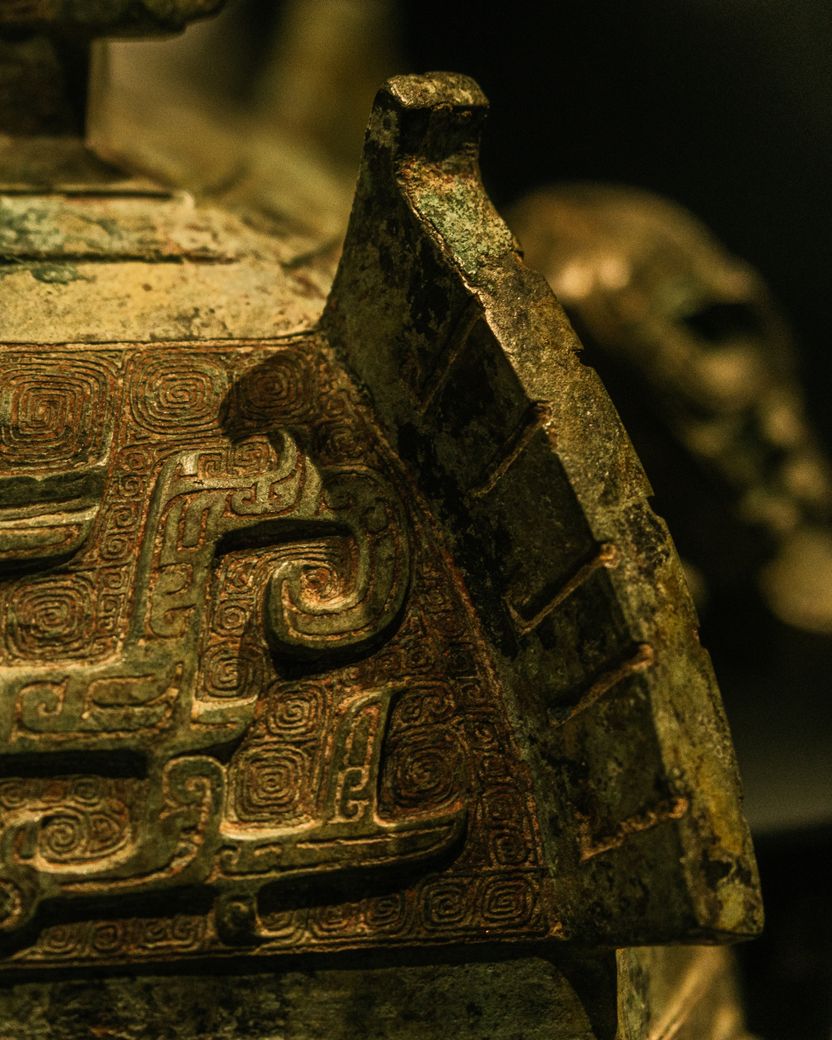
What foundries call bronze for sculpture is usually silicon bronze — CuSi3Zn3Mn, CC493K — rather than the classical copper-tin alloy. Silicon bronze flows well into fine detail, welds cleanly with matched filler, and takes patina evenly. Casting is either lost-wax, which reproduces surface modelling faithfully enough to preserve a fingerprint from the original clay, or resin-bonded sand for larger sectional work with the detail restored by hand chasing afterwards. Internal armatures are 316 stainless, designed as structural members wherever the piece stands on fewer than four points.
Over time
How it weathers
An applied hot patina is a controlled chemical conversion of the surface, not a coating. Left outdoors, it continues to evolve: browns deepen, greens spread into sheltered detail, and highlights polish bright where hands and clothing touch. This is the material behaving correctly and it is why bronze is specified for pieces the public will use. Unwaxed bronze in an urban atmosphere will eventually develop a dark, even sulphide layer; unwaxed bronze near the sea develops green copper chlorides more quickly and less evenly.
Specifying it
When to specify it
Specify bronze where the subject is figurative or animal, where surface modelling carries the work, where the piece will be touched, and where permanence is the point — memorials, civic commissions, anything intended to outlast its setting. Do not specify it where floor loading is constrained, where the programme is under sixteen weeks, or where the budget is fixed at the level a fabricated or composite piece would occupy. It is the most expensive material per metre of height in our range and the honest reason is labour: chasing a large sectional casting is weeks of skilled hand work.
The drawback
Runoff and staining
What this material does to the surfaces underneath and around it, and what that costs to put right.
Bronze does stain adjacent surfaces, and it is under-discussed. Copper compounds washing off a patinated surface produce green-blue streaking on light stone, concrete and render beneath and around the piece, and unlike corten this does not stop after two years — it continues for the life of the work, though it slows once the patina matures. On white marble or pale limestone the staining is highly visible and difficult to remove without damaging the stone. The mitigations are the same in principle as for corten and more important in practice: a drip detail at the base, a dark or planted margin beneath the piece, and honest advice at design stage against setting a large patinated bronze directly on a pale stone plinth. The second drawback is cost of correction: a patina that goes wrong cannot be touched up convincingly in situ, because a local reapplication never matches the surrounding surface. It has to be stripped back and redone by a specialist, which on a large piece means scaffolding and containment.
Upkeep
Maintenance
What is genuinely required, and what is sold as required and is not.
Wash annually with clean water and a soft brush, dry, then apply microcrystalline wax warm and buff. Remove bird fouling promptly — it is acidic and will etch a patina. Never pressure wash and never use abrasives: both cut through the patina to raw metal and leave a bright scar that takes years to blend. Lacquered and polished bronze is a different regime altogether, requiring workshop recoating on roughly a five-year cycle.
For the specification
Technical data
CuSi3Zn3Mn (CC493K). Density 8,530 kg/m³. Typical cast wall thickness 5–10 mm for sculpture, which is why a 3 m animal runs to 1,200–1,600 kg rather than solid weight. Tensile 350–450 MPa. Pouring temperature approximately 1,150°C. Sections TIG welded with matched filler and chased. Patina applied at 80–200°C surface temperature. Service life outdoors measured in centuries.
Speak to an engineer
Whether cast bronze for sculpture is right for your site depends on exposure, footfall and who maintains it. Describe the position and we will tell you what we would specify, and what we would not.
We respond to every quote request within one working day