Capabilities
Bronze Casting
Casting quality is decided at the pour and at the chasing bench, and it cannot be corrected later. Silicon bronze is poured to both lost-wax and sand processes, welded up and chased by hand until the modelling runs continuously across every join.
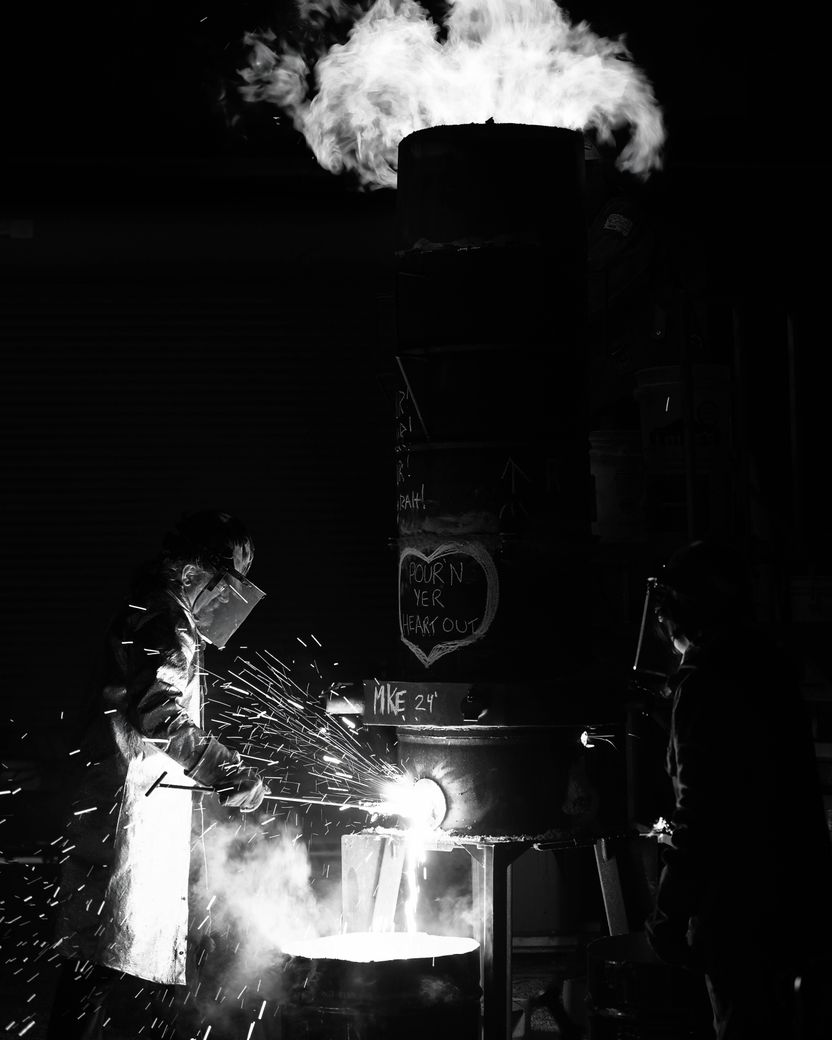
In the workshop
What we do
Below about a metre we cast by the lost-wax process, which reproduces surface modelling faithfully enough that a fingerprint in the original clay survives into the finished metal. Silicone moulds are taken from the original, wax positives poured and hand-dressed, invested in a ceramic shell built up over five to seven coats, burned out at 750 degrees and poured at 1,150. Above roughly three metres wax becomes unmanageable and the work moves to resin-bonded sand casting in sections, with surface detail restored by hand chasing after assembly. Sectioning is designed into the model at the outset so joints fall where the form can absorb them, and on constrained sites so that every section passes the actual access route. Sections are TIG welded with matched filler, then chased with pneumatic and hand tools until no join can be found by eye or by hand. Patination is done hot: ferric nitrate and cupric nitrate for browns, ammonium chloride and copper compounds for greens, liver of sulphur for blacks, applied to metal held between 80 and 200 degrees so the colour bonds into the surface. Every patina is proofed on a sample cast from the same melt, because alloy variation shifts colour. Finished work is sealed with microcrystalline wax applied warm. Internal armatures are stainless, designed by the engineering team, and installed before the sections are closed.
Stage by stage
How it runs
Typical durations for this stage. They are what we programme against, not best cases.
Mould making
Silicone moulds taken from the approved original or the milled pattern, with a rigid mother mould.
Typical duration: 1–2 weeks
Wax or sand preparation
Wax positives dressed by hand, or resin-bonded sand moulds built for sectional casting.
Typical duration: 2–3 weeks
Pour and devest
Ceramic shell burned out and poured at 1,150°C, then devested and cleaned.
Typical duration: 1–2 weeks
Welding and chasing
Sections TIG welded and chased by hand until the modelling runs continuously.
Typical duration: 3–6 weeks
Patination and wax
Hot patina applied against an approved sample, sealed with microcrystalline wax.
Typical duration: 1 week
Plant and codes
Equipment and standards
Named machinery, the codes we work to, and the certifications behind them.
The plant list and workshop headcounts are not published yet. Ask us and we will send the current equipment register.
In the meantime
- How this discipline runsThe stages above, with the durations we programme against.
- All capabilitiesThe other seven disciplines a commission passes through.
- Inside the factoryWhat we can say about the plant today, and what is still being confirmed.
At handover
What you receive
Drawings, calculations, files and certificates issued as part of the commission — not on request.
Cast, welded, chased and patinated work; approved patina sample panel; material certification for the alloy; and a maintenance schedule for the specified patina.
Need bronze casting on a live project?
Send the drawing, the model or the photograph you have. We will tell you what is achievable at that scale, what it will take, and what it will cost.
We respond to every quote request within one working day